Poetry in the Room: CPD
Feel more confident using poetry as a therapeutic aid
This CPD workshop offers a practical, professionally grounded introduction to using poetry in therapy. Designed for counsellors, therapists and trainees, it focuses on building confidence in using poetry as a creative and accessible therapeutic tool.
Delivered over one 3 hour evening session in Newton Abbot, the course explores how poetry can support emotional expression, reflection and new perspectives within the therapeutic relationship. Drawing on the wider context of bibliotherapy, participants will gain simple, effective techniques they can use immediately in practice.
The workshop balances brief theoretical input with experiential learning, giving participants the opportunity to reflect, practise, and develop their own style of working with poetry in a safe and supportive environment.


Interest in creative approaches within counselling and psychotherapy has grown significantly in recent years. Increasingly, both clients and practitioners are recognising the value of working beyond purely verbal processing, using approaches that support emotional expression, reflection, and deeper insight.
Why Introduce Poetry Into Your Practice?
For many therapists, poetry offers a powerful and accessible therapeutic tool. It can help clients express what feels difficult to say, create distance from overwhelming experiences and open up new perspectives through metaphor and imagery. In this way, poetry can support emotional processing in ways that are not always accessible through conversation alone.
At the same time, using poetry in therapy is not simply a matter of bringing a poem into the session. It requires careful consideration around timing, client readiness, and how to work safely and ethically with the responses poetry may evoke.
You may find yourself asking:
How do I introduce poetry into counselling sessions in a natural way?
What types of poetry are suitable for different clients or therapeutic goals?
How can poetry support emotional expression and insight in therapy?
When is poetry helpful in therapy, and when might it not be appropriate?
How do I use poetry safely within ethical and professional practice?
This CPD workshop is designed to explore these questions directly. It provides a clear and practical framework for using poetry in therapy, grounded within the wider context of bibliotherapy and creative therapeutic approaches.
By combining experiential learning with reflection and skills-based practice, the course supports therapists to integrate poetry into their work in ways that are confident, ethical, and clinically effective.
The Content

Teaching combines brief theoretical input with experiential exercises and reflective discussion, allowing participants to directly experience how poetry can be used within the therapeutic process.
The course is designed to help practitioners integrate poetry into their work in a way that feels natural, ethical, and clinically meaningful.
The workshop covers areas including:
An introduction to poetry within bibliotherapy and creative therapeutic approaches
Using poetry to support emotional expression, reflection and insight
How to introduce poetry safely and appropriately in sessions
Working with client responses to poetry
Selecting and using different types of poems
When poetry may be helpful and when it may not be suitable
Simple, adaptable poetry-based interventions
Reflective use of poetry within your own practice
Who is the Course For?
This CPD workshop is suitable for:
• Qualified counsellors
• Psychotherapists and therapists
• Coaches and mental health practitioners
• Counselling trainees with appropriate experience
Participants should have an interest in creative approaches to therapy and be open to exploring poetry as a therapeutic tool. A willingness to engage in reflective and experiential learning will help you get the most from the workshop.
An Experiential Learning Environment

This training is intentionally experiential.
The workshop takes place in person at the college, providing a focused and supportive learning environment where participants can explore the use of poetry within therapeutic practice.
Through a combination of guided exercises, group discussion, and reflective work, participants will experience directly how poetry can support emotional expression, insight, and connection within the therapeutic process.
Experiential activities are supported by brief theoretical input, linking practice to ethical awareness, creativity, and reflective thinking.
The session is designed to be engaging, practical, and immediately applicable, allowing participants to leave with both a deeper understanding and tools they can confidently begin using in their work.
Your Tutor

Sami Choudhury MNCPS (Accred.)
Sami is a counsellor and tutor based in Torbay, working in both private practice and alongside a range of local charities. His work is rooted in a trauma-informed approach, with a particular interest in the relationship between trauma and loss, and how these experiences shape the way people connect, express and make meaning.
Alongside his therapeutic work, Sami has experience as a mindfulness teacher within educational settings. The qualities of gentle awareness and compassion that underpin mindfulness continue to inform how he sits with clients and how he supports learning within the training space.
Sami’s journey into counselling began as a client, and that lived, experiential understanding remains central to his work. He values the balance between ‘unknowing’ and professional knowledge, trusting the process while also drawing on a solid background in education. Since 2006, he has worked in a variety of roles including tutoring, teaching, safeguarding, and supporting older teenagers and young adults, particularly those with neurodivergent experiences.
Creativity is a vital thread throughout Sami’s practice. He brings a deep appreciation for music, movement, poetry and the visual arts, seeing them as powerful and often overlooked languages of expression. Within this CPD, poetry is approached not as something to analyse or perfect, but as a way of gently accessing feeling, meaning and connection in therapy.
Course Structure & Date
The Poetry in the Room CPD runs for 3 hours on:
30th June 2026
6pm - 9pm
Numbers are limited to support experiential learning.
Course fee: £45 per person

Why Step by Step Counselling Training?
We are an independent training provider offering a thoughtful, grounded approach to counselling education.
Small, supportive learning environments (maximum 13 in a group)
Teaching that integrates theory with lived experience
Clear ethical boundaries and professional standards
Emphasis on skills practice and reflective learning
Tutors who teach from real practice, not just textbooks

We are not a large institution. We are intentional, human and focused on quality.


Meet the Team
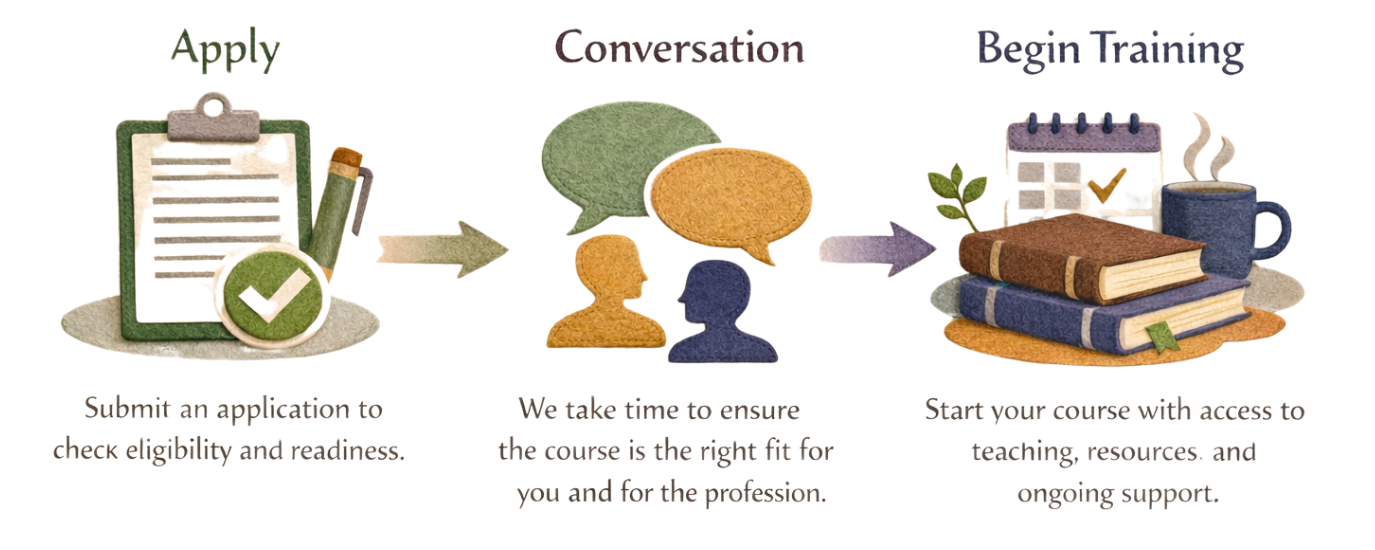
How Applying Works